 The Comprehensive Harvard Medical School Diabetes Update 2021
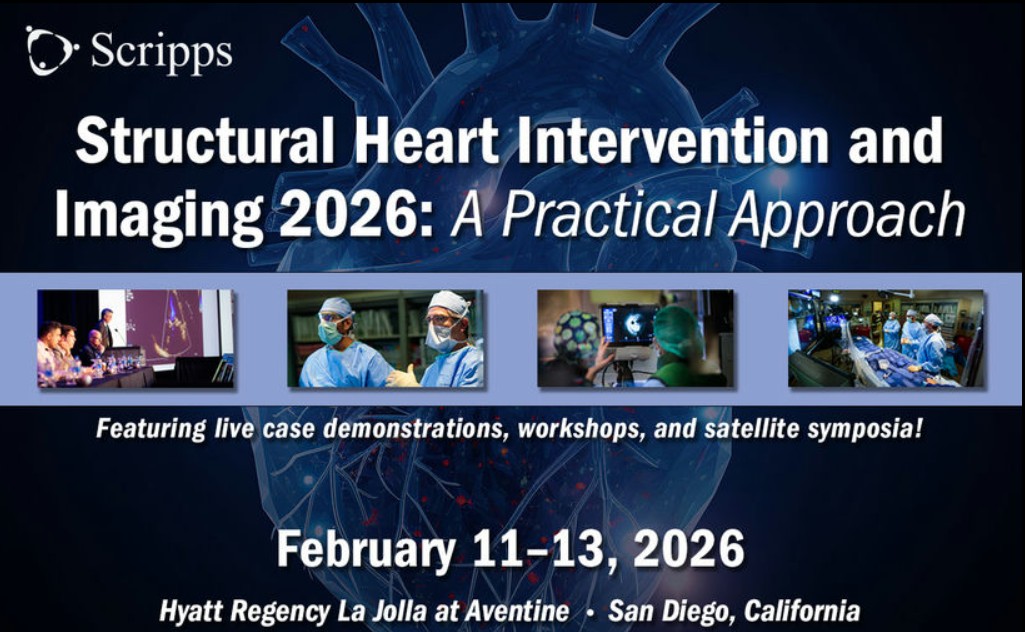
Scripps Structural Heart Intervention and Imaging 2026
$40
Scripps Structural Heart Intervention and Imaging 2026
YOU WILL GET THE COURSE VIA LIFETIME DOWNLOAD LINK (FAST SPEED) AFTER PAYMENT
Videos Only no PDFs
Overview
The Scripps Structural Heart Intervention and Imaging course delivers a practical, state-of-the-art, live case-based review of structural heart disease interventions and cardiovascular imaging. Emphasizing multidisciplinary collaboration, the program features expert faculty, including interventional cardiologists, echocardiologists, electrophysiologists, cardiothoracic surgeons, anesthesiologists, and sonographers. The course will cover clinical guidelines on patient selection, pre-procedural evaluation, procedural techniques, imaging integration, and challenges, concluding with outcome assessments and future innovations in the field.
Objectives
Upon completion of this activity, participants should be able to:
- Build and optimize a multidisciplinary team of health care professionals to ensure appropriate management of patients with structural heart disease.
- Identify the equipment and imaging technologies necessary to perform structural heart disease interventions.
- Apply a comprehensive approach to the assessment of the aortic, mitral, and tricuspid valves, the interatrial septum, and the left and right ventricles, using echocardiography (TTE, TEE, and ICE), CT, and MRI for the purpose of the interventional treatment of these cardiac structures.
- Outline the current indications for LAA closure, PFO closure, transcatheter aortic valve replacement (TAVR), transcatheter mitral valve replacement (TMVR), and mitral transcatheter edge to edge repair (TEER).
- Evaluate echocardiographic and CT imaging before and after LAA closure, and identify and measure peri-device leaks, device-related thrombus, and other potential complications.
- Identify appropriate treatment strategies for patients with mitral valve disease (i.e., TEER or TMVR) or tricuspid valve disease (i.e., TEER or TTVR) based upon imaging findings.
- Incorporate live TEE multiplanar imaging to optimize transcatheter mitral and tricuspid valve intervention.
- Apply 2D and 4D ICE during structural heart intervention.
- Recognize the risk of left ventricular outflow tract obstruction after TMVR and coronary occlusion after TAVR and apply specific interventional strategies to prevent them (e.g., LAMPOON and BASILICA).
- Integrate emerging data regarding surgical risk, including low and intermediate-risk patients into TAVR decision-making.
- Recognize heart failure patients who might benefit from novel interventional strategies, such as interatrial shunt devices, to improve symptoms.
- Optimize the anesthetic management of patients with reduced ejection fraction undergoing TEER or TMVR.
- Employ best practices to safely manage potential complications of catheter-based therapies for structural heart disease.
| Sr. No. | Session Title | Speaker(s) | Duration |
|---|---|---|---|
| 1 | Interatrial Shunts for HFpEF and HFrEF: Device and Data Update | Rajeev Mohan | 13:48 |
| 2 | Interpreting CT Imaging After LAAO: Leaks, HAT, DRT, and Device Positioning | Markus Scherer | 10:51 |
| 3 | Current State-of-the-Art to Assess Right Ventricular Function by TEE, CT, and MRI | Markus Scherer | 11:58 |
| 4 | LAAO is Safe Until It’s Not: Untoward Events During and After the Procedure and How to Prevent Them | Seun Alli | 12:34 |
| 5 | Atrial Function Mitral Regurgitation: Identification, Mechanism, and Potential Treatments | Steven Romero | 16:12 |
| 6 | TEE vs. 3D ICE for LAAO Procedural Guidance: Strengths, Weaknesses, and How to Choose | Gagan Singh | 13:05 |
| 7 | Right Ventricle: Clinical-Pathological Correlations | Douglas Shook | 17:34 |
| 8 | Mitral Valve: Clinical-Pathological Correlations | Douglas Shook | 18:19 |
| 9 | Lead-ing into Trouble: How to Identify Lead-Tricuspid Leaflet Interaction | Nadira Hamid | 11:18 |
| 10 | Mitral TEER for Moderate SMR: Is it Time? | Anita Asgar | 10:51 |
| 11 | Cutting Edge MR Assessment: Quantification, Mechanism, and Pathology | Kosta Koulagiannis | 13:22 |
| 12 | InterLeaflet Deployment for Mitral Valve Procedures with Threatened NeoLVOT Obstruction | Amar Krishnaswamy | 12:09 |
| 13 | Deep Dive and Clinical Implications of the ENCIRCLE Trial: Patient Selection and Technique for Balloon-Expandable-in-Dock TMVR | David Daniels | 09:53 |
| 14 | Concomitant LAA Closure and Mitral TEER: Current Evidence and Procedural Considerations | Jason Rogers | 12:26 |
| 15 | Imaging for Transseptal Puncture to Optimize Safety and Procedural Success | Edris Aman | 18:04 |
| 16 | Tricuspid Valve: Clinical-Pathological Correlations | Douglas Shook | 15:02 |
| 17 | Aortic Insufficiency: Imaging Evaluation and Indications for Intervention | Markus Scherer | 11:50 |
| 18 | Cutting Edge Assessment of TV (ECHO) TR Quantitation and Mechanisms of Action | Nadira Hamid | 10:00 |
| 19 | Cutting Edge TR Echo Assessment: Screening for T-TEER, TTVR | Kosta Koulagiannis | 18:40 |
| 20 | Tricuspid Surgery for TR: Technique, Outcomes, and Lessons Learned from Transcatheter Experience | Gorav Ailawadi | 12:21 |
| 21 | Optimizing T-TEER Outcomes: How to Identify the Right (and Wrong) Patient | Gagan Singh | 15:19 |
| 22 | CEP for TAVR: Philosophical Perspective | Rishi Puri | 11:59 |
| 23 | Imaging Strategies to Confirm Leaflet Grasping in T-TEER | Edris Aman | 16:45 |
| 24 | TTVR Patient Selection Considerations | Rahul Sharma | 07:21 |
| 25 | Case Presentation: Keys to Enhance Procedural Safety During TTVR | Rahul Sharma | 08:56 |
| 26 | Hands Off the Valve! The Role of Caval Valve Implantation (CAVI) in Severe TR | Rishi Puri | 11:51 |
| 27 | TAVR 2026 Overview: What’s New? | Paul Teirstein | 17:11 |
| 28 | Aortic Valve: Clinical-Pathological Correlations | Douglas Shook | 12:26 |
| 29 | Procedural Planning for Lifetime TAVI Management and L |
Related products